Victoria Arbour found the skull on Hornby Island, just off the east coast of Vancouver Island. It turned out to be a new species of dinosaur never before seen, and a first for this particular kind of dinosaur ever being found in Canada.
The pterosaur, a flying reptile that lived more than 70 million years ago, could have been a scavenger, Arbour says.
More in www.torontosun.com
Showing posts with label dinosaur. Show all posts
Showing posts with label dinosaur. Show all posts
1.13.2011
New dinosaur species discovered in B.C. had piranha-like teeth

Dinosaur visits CherryVale Mall
A 35 foot tall dinosaur named Jobaria was unveiled Thursday, Jan. 13, 2011, at CherryVale Mall. The Jobaria display is a preview for the Giants: African Dinosaurs exhibit at the Burpee Center Museum of Natural History from Feb. 19 to May 15.
More in www.rrstar.com

Hey, interested in robotic dinosaurs from China?
So if you look just below the end of this post, you'll see my bio. All of us here at Crave have similar bios, including contact information. Consequently, we get a ton of e-mails. Some are from readers (and I'm sorry I don't have time to respond to them all). We also get e-mails from manufacturers in China.
More in news.cnet.com

Meet Eodromaeus, world's oldest dinosaur found so far
After some 230 million years of anonymity, a dinosaur called Eodromaeus greeted the world today.
During a routine excavation, a group of paleontologists found what they believed to just be well-preserved samples of bones of a known line of dinosaurs. But, instead, they had unearthed Eodromaeus (“dawn runner”), a previously undiscovered dinosaur whose existence provides information about life in the earliest era of dinosaurs and gives scientists clues about the evolution of the animal.
More in news.medill.northwestern.edu

1.04.2011
Missing dinosaur back home in yard
DANVILLE, Calif., Dec. 31 (UPI) -- A dinosaur sculpture that disappeared from a Danville, Calif., front yard has been found and returned to its proper place, its owner says.
"She's in perfect shape, absolutely perfect shape," said Eileen Johnson, owner of 5-foot tall, 10-foot long metal sculpture named "Emily Brontosaurus." The sculpture was taken sometime Monday night or Tuesday morning, the Contra Costa Times reported.
More in UPI.com
11.09.2010
Dinosaur World expansion to double size of attraction
PLANT CITY - Dinosaur World will break ground Thursday on an expansion project to more than double the size of the tourist attraction.
The 12-acre expansion will include a 22,000 square-foot building to house a museum with a prehistoric theme, gift shop and office space. More dinosaur replicas will be added to the 150 already at the attraction at 5145 Harvey Tew Road, just off Interstate 4 at Branch Forbes Road. Some woolly mammoth replicas may also be added.
Other new features will include a playground, more parking and larger picnic areas.
More in TBO.com

11.04.2010
Dinosaur eggs for sale at auction
The Saudi Arabic language daily Alyoum reported on Wednesday, November 3, 2010, that an unidentified Saudi Arabian is planning to hold the world’s first auction of dinosaur eggs.
The sale is expected to raise nearly SR1.5 million ($5.6 million).
The sale will occur at a private exhibition hall owned by well-known Saudi geologist Abdulla Aladeeni in the eastern town of Dhahran.
More in examiner.com

11.03.2010
Baby dinosaur's running footprints discovered
Discovery may prove young sauropods could run on hind legs
A baby dinosaur approximately the size of a pug dog scurried alongside what may have been its mom or dad 148 million years ago in what is now foothills near Denver, scientists reported Monday at the annual meeting of the Geological Society of America in Denver.
They caught the paleo-action in the footprints left behind there near the town of Morrison, Colo. The scientists think the dinosaur prints, a set of infant prints next to partial prints from an adult, belonged to Apatosaurus, a sauropod — giant, long-necked dinosaurs that preferred veggies — and once known as Brontosaurus.
More in msnbc.com

3.29.2010
Tyrannosaur Bone Found - The finding in Australia could change everything we know about the T-Rex.
Tyrannosaur bone found is now changing science as we know it today. Scientists for the first time have evidence of an ancestor T-Rex located in the Southern Hemisphere. Archeologists believed that the dinosaur was restricted to the Northern Hemisphere.
"For some reason, in the north tyrannosaurs became exceptionally successful predators, and in the south, they just dwindled away," paleontologist Roger Benson said in a statement.
Bones from the dinosaur species had been documented only in Asia, Europe and North America, but one's hip bone has been located in Australia. It's a remarkable finding. The team identified a 30cm hip located at Dinosaur Cove in Victoria as belonging to an ancestor of Tyrannosaurus rex.
More in newsoxy.com

Dinosaur Buried Alive By Collapsing Sand Dune
A plant-eating dinosaur might have been swallowed up by a collapsing sand dune some 185 million years ago in what are now Utah's red rocks.
A plant-eating dinosaur might have been swallowed up by a collapsing sand dune some 185 million years ago in what are now Utah's red rocks. The desert disaster likely plopped the dinosaur onto its head, where it remained until being discovered by a local historian and artist in 2004.
Joe Pachak was hiking in the Comb Ridge area near Bluff, Utah, when he spotted the bony fossil protruding from the multicolored cliffs of the Navajo Sandstone, which represents the remains of a huge sand dune desert as large as the modern-day Sahara Desert. As such, the dinosaur has been named Seitaad ruessi, derived from the Navajo word "Seit'aad," a sand-desert monster from the Navajo creation legend.
In 2005, museum paleontologists and crews excavated and collected the specimen, which included most bones of the skeleton, except for the head, and parts of the neck and tail. The missing parts were lost to erosion over the past thousand years, but were almost certainly visible when Native Americans lived on the cliff just above the skeleton, the researchers say.
More in Foxnews.com

Road runner dinosaur revealed in China
Road runner, meet your dinosaur predecessor, an "extreme" runner unearthed by an international paleontology team in central China.
In the journal Zootaxa, a team led by Xing Xu of the Chinese Academy of Sciences reports, Xixianykus zhangi ('SHEE-shya-nye-kus jong-eye') describes a pint-sized, two-legged sprinter from about 85 million years ago. The fossil's legs, hips and backbone adds to growing evidence that the dinosaur's "parvicursorine" kindred, "represent extreme cursors (runners) among non-avian dinosaurs," says the study.
""The limb proportions of Xixianykus are among the most extreme ever recorded for a theropod dinosaur," says study researcher Corwin Sullivan, also of the Chinese Academy of Sciences, in a statement. "This doesn't provide a basis for estimating its top speed, but it does show that Xixianykus was a highly efficient runner."
More in content.usatoday.com

3.04.2010
Researchers Identify Fossil of Dinosaur-Eating Snake
The discovery of a snake near an egg is by no means unusual, but in this case, the snake was 67 million years old — providing scientists with new information about how snakes in the dinosaur era lived, and what they ate.
The fossilized scene is a striking one and the first of its kind: the 11.5-foot-long snake is coiled around a cracked egg and surrounded by several more eggs. Nearby is a dinosaur hatchling, newly emerged from the cracked egg.
The researchers believe that the snake was eyeing the dinosaur baby as a meal. Their findings appear in Tuesday’s issue of the PLoS Biology journal.
“It’s a chance to understand the biology and early anatomy,” said Jeffrey A. Wilson, the paper’s lead author and a paleontologist at the University of Michigan. “The really important thing is that it’s actually caught in the fossil record showing what it’s doing.”
More in The New York Times
Scientists Discover Earliest Known Dinosaur Relative
Scientists have announced the discovery a relative of dinosaurs that lived ten million years earlier than the oldest known dinosaurs. Paleontologists say the creature will improve their understanding of prehistoric animals.
The fossils of Asilisaurus kongwe were recovered by paleontologists in a large bone bed in Tanzania in 2003.
The creature, which shared many characteristics of dinosaurs but lacked many key features, lived 240-million years ago in the middle Triassic period before any known dinosaur. The earliest dinosaur fossils date back 230-million years.
More in Voanews.com

2.25.2010
Crime Waves: Night at the Museum
Bronx Criminal courts are in chaos! Madoff-affiliated Ponzi schemers are still getting busted! Bar-brawling firefighters have turned themselves in!
Even guards at the American Museum of Natural History are getting criminal: When they're not protecting dinosaur dioramas, they're stabbing one another in taverns.
More in The New York Observer

The last word: A dinosaur from space
Two days after last month’s devastating earthquake in Haiti, Ed Lu, Google’s programme manager for advanced projects, was fielding a rapid succession of phone calls over lunch. Mr Lu was liaising between Google and the US government as the Silicon Valley technology group tried to get updated satellite photos to first responders on the ground.
Not many Googlers could fill this critical role during a time of crisis. But Mr Lu’s unusual CV made him ideally suited for the job. Before joining the company in 2007, Mr Lu was an astronaut at Nasa, where he commanded the International Space Station and the Space Shuttle. “I know a lot of people in the State Department and the Department of Defence,” he says. “I’m trying to cut through the red tape.”
Google employs more than 20,000 people, but Mr Lu is the only one to have travelled in space.
Still, hiring Mr Lu was not an obvious move for Google. The famously laid-back search company makes its money through advertising. And while Nasa, like Google, is a large organisation with a grand mandate and technically complex systems, Mr Lu had no experience of working for internet companies.
More in FT.com

2.24.2010
Island of dwarf dinosaurs did exist
An island of "dwarf dinosaurs" which was only a theory for 100 years really did exist, scientists have announced.
The idea of the small prehistoric beasts on Hateg Island, Romania, was proposed 100 years ago by the colourful Baron Franz Nopcsa, whose family owned estates in the area.
He found that many dinosaur remains on Hateg were half the size of their close relatives in older rocks in England, Germany, and North America.
The baron's theory has been tested for the first time by Professor Mike Benton at the University of Bristol, and six other authors from Romania, Germany, and the United States.
The team found that the Hateg Island dinosaurs were indeed dwarfs and not just young dinosaurs.
More in Press Assocaition
New Long-Necked Dino Species Discovered in Utah
A mom's wise words about chewing your food likely got lost on a giant, long-necked dinosaur that lived about 105 million years ago in North America. That's according to analyses of four skulls from a newly identified dinosaur species.
A mom's wise words about chewing your food likely got lost on a giant, long-necked dinosaur that lived about 105 million years ago in North America. That's according to analyses of four skulls from a newly identified dinosaur species.
"They didn't chew their food; they just grabbed it and swallowed it," said study team member Brooks Britt, a paleontologist at Brigham Young University.
Paleontologists discovered the four skulls, two of which whose bones were fully intact, from a quarry in Dinosaur National Monument in eastern Utah. Now called Abydosaurus mcintoshi, the dinosaur species is a type of sauropod (long-necked plant-eaters) and is most closely related to Brachiosaurus that lived 45 million years earlier.
More in FOXNews.com

2.23.2010
Dinosaurs found in China had colorful, striped feathers, scientists declare
Some dinosaurs had russet-colored feathers, and one jazzy specimen had a Mohawk crest and stripes, researchers say in the first reports to confidently assign colors to dinosaurs.
In the new study, reported in the online edition of the journal Science, scientists focused on melanosomes, cell components that impart color. They were able to assign color to individual feathers and thus work out color patterns for the entire fossil of Anchiornis huxleyi, a small, feathered, two-legged dinosaur that lived roughly 150 million years ago. The animal weighed about four ounces and appears to have had a dark gray or black body and wings with some white feathers that gave it a stripe pattern, plus a reddish-brown crest and speckles on the face.
More in The Washington Post

2.22.2010
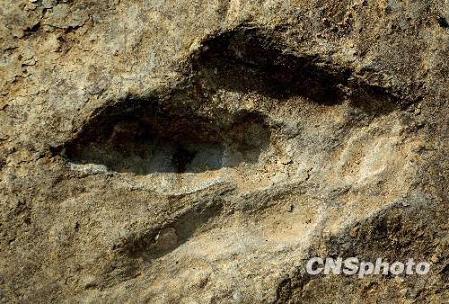
World's largest group of dinosaur footprints discovered in Shandong
Recently, a large group of dinosaur footprints were discovered at Zhucheng city, Shandong province. Paleontologists from Chinese Academy of Sciences and Chinese Academy of Geological Sciences came to the location and confirmed the collection to be the largest ever discovered.
The group of footprints is located in an area of more than 2,600 square meters, and more than 3,000 footprints of different kinds of dinosaurs appear in various shapes and sizes.
More in english.people.com.cn
2.21.2010
Prehistoric island 'Jurassic Parkette' ruled by dwarf dinosaurs found
Paleontologists have discovered a prehistoric "lost world" which was ruled by miniature dinosaurs.
Sort of a pigmy Jurassic Park, the island was the hometown of dinos who were up to eight times smaller than some of their mainland cousins, reports The Telegraph.
Dwarf dinosaurs' fossils were found in what is now modern day Romania, in an area known as Hateg, which, 65 million years ago - when the creatures were living there - was an island, reports The Telegraph.
One of the fossils was of Magyarosaurus, which was little bigger than a horse, but was related to some of the largest creatures to ever walk the Earth - gigantic titanosaurs such as Argentinosaurus, which reached up to 100 feet long and weighed around 80 tons.
More in oneindia
Subscribe to:
Posts (Atom)


